What Is the Smith Maneuver (Manoeuvre)? A Beginner's Guide for Canadians#
This article explains concepts, options, and rules in Canada for general information only. It is not financial, tax, legal, or investment advice.
Homeowners in Canada quickly notice a key difference from the United States: mortgage interest is generally not tax-deductible. Every dollar of interest you pay to the bank simply disappears.
The Smith Manoeuvre (also spelled Smith Maneuver in American English) is a strategy designed to change that — legally turning your mortgage into a tax-deductible investment loan over time, while simultaneously building a growing investment portfolio alongside your home equity.
Both spellings refer to exactly the same strategy. "Manoeuvre" is the standard Canadian and British spelling; "Maneuver" is the American spelling you may encounter when searching online. This guide uses both interchangeably.
It sounds complex. Once you understand the mechanics, it is actually quite elegant.
The Problem It Solves#
In the US, homeowners can deduct mortgage interest from their taxable income. In Canada, they cannot — but there is an important exception buried in the Income Tax Act:
Interest on money borrowed to earn investment income is tax-deductible in Canada.
A conventional mortgage does not qualify because the borrowed money was used to buy a home (a personal-use asset), not to earn income. The Smith Manoeuvre exploits this distinction by restructuring how the debt is categorised — not by doing anything exotic or questionable.
Who Invented It?#
The strategy is named after Fraser Smith, a Victoria, B.C. financial planner who described it in his 2002 book Is Your Mortgage Tax-Deductible? It has been used by Canadians ever since, and the CRA has never challenged the core structure when implemented correctly.
While the Smith Manoeuvre is a well-established legal strategy, tax law is complex and your personal situation matters. Consult a fee-only financial planner or tax advisor before implementing it.
How It Works: The Mechanics#
The Smith Manoeuvre requires three things:
- A readvanceable mortgage — a mortgage product that automatically makes your home equity available as a Home Equity Line of Credit (HELOC) the moment you pay down principal.
- A HELOC (Home Equity Line of Credit) — the borrowing facility attached to your readvanceable mortgage.
- A non-registered investment account — where the borrowed funds are invested to earn income.
Here is the cycle, step by step:
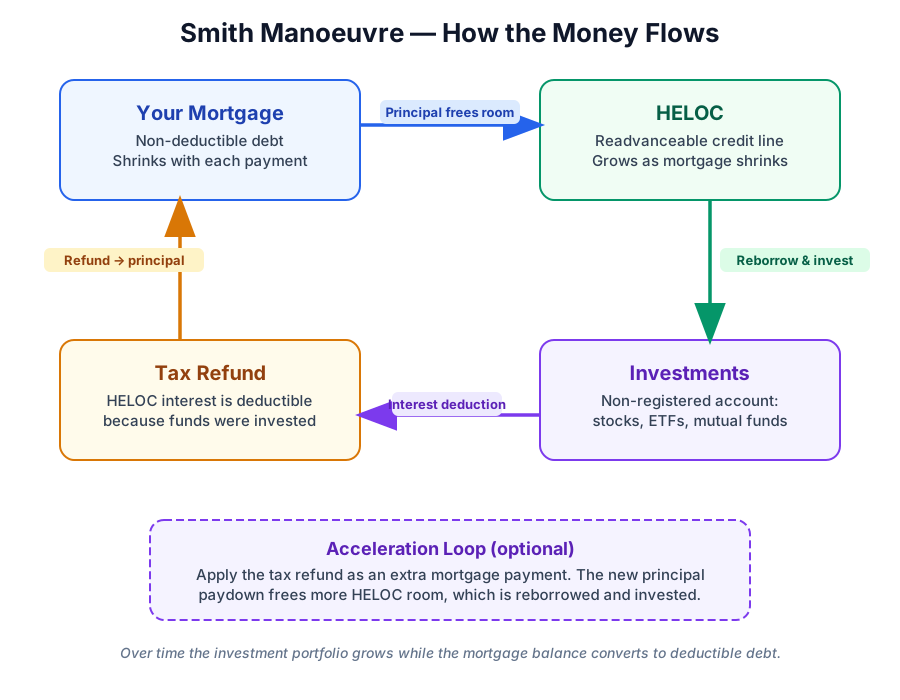
Diagram: mortgage principal paydown is reborrowed through the HELOC, invested in a non-registered account, and deductible interest may generate a tax refund that can optionally be applied back to mortgage principal.
Step 1: Make Your Regular Mortgage Payment#
You pay your normal monthly mortgage payment, which includes principal and interest. The principal portion reduces your mortgage balance.
Step 2: Reborrow the Principal You Just Paid Down#
Because you have a readvanceable mortgage, that same principal amount becomes immediately available as HELOC room. You immediately reborrow it.
Step 3: Invest the Reborrowed Amount#
The reborrowed funds go directly into income-producing investments — typically Canadian dividend-paying stocks or equity ETFs that produce dividends or distributions.
Step 4: Claim the HELOC Interest as a Tax Deduction#
Because the borrowed money was used to earn investment income, the HELOC interest qualifies as a tax deduction. At the end of the year, you receive a tax refund.
Step 5 (Optional but Powerful): Reinvest the Tax Refund#
Many people take that tax refund and make a lump-sum payment on the mortgage principal, then immediately reborrow and invest it again — accelerating the cycle.
A Visual Overview#
| Standard Mortgage | Smith Manoeuvre | |
|---|---|---|
| Mortgage interest | ❌ Not deductible | ❌ Not deductible |
| HELOC interest | — | ✅ Tax-deductible |
| Investment portfolio | None | Growing each month |
| Tax refund each year | None | ✅ Yes (from HELOC interest) |
| Net worth at end | Home equity only | Home equity + investments |
A Simple Example#
Suppose you have:
- Mortgage balance: $500,000
- Mortgage rate: 5.5%
- Amortization: 25 years
- HELOC rate: 7.2%
- Investment return: 7% per year
- Annual income: $100,000 (Ontario, ~43.2% marginal rate)
- Dividend yield on investments: 3%
Each month, as your mortgage principal decreases, you reborrow that same amount through the HELOC and invest it. The HELOC interest is deductible, saving you roughly $0.43 for every dollar of HELOC interest in this example.
Over 25 years:
- Your mortgage is fully paid off (same as without the strategy — your payment schedule does not change)
- You have accumulated a substantial investment portfolio funded by reborrowed equity
- You have received cumulative tax savings from the HELOC interest deductions each year
- If you reinvested those refunds into the mortgage, you paid off your home faster and invested more
The net result: you end up with both a paid-off home and an investment portfolio, rather than just a paid-off home.
What Are the Risks?#
The Smith Manoeuvre is not a free lunch. There are real risks to understand:
Investment Risk#
You are borrowing money to invest. If your investments lose value, you still owe the HELOC balance. A sustained market downturn (like 2008–2009 or early 2020) while carrying HELOC debt can be psychologically and financially stressful.
Interest Rate Risk#
HELOC rates are typically variable. If rates rise sharply, your deductible interest costs increase — which helps your deduction, but also means you are paying more in interest.
Leverage Risk#
You are effectively leveraging your home. This amplifies both gains and losses. It is not appropriate for everyone, particularly people close to retirement or with unstable income.
Discipline Required#
The strategy only works if you continuously reborrow and reinvest, rather than spending the HELOC room. It requires consistent, automated habits.
The CRA requires that borrowed funds be used for investments that have a reasonable expectation of earning income. Growth-only assets with no dividends or distributions may not qualify interest for deduction. Consult a tax professional.
Who Is It Best For?#
The Smith Manoeuvre is generally most suitable for people who:
- Have a readvanceable mortgage (or can convert to one)
- Have a long time horizon — the strategy pays off more over 15–25 years
- Are in a high marginal tax bracket — the higher your rate, the more valuable the interest deduction
- Have stable employment income — it is often necessary to be comfortable carrying investment debt
- Are emotionally comfortable with market volatility — you will hold leveraged investments through downturns
- Can automate the mechanics — the monthly reborrow-and-invest cycle must be consistent
Does the CRA Allow This?#
Yes. The Canada Revenue Agency has repeatedly confirmed that interest on money borrowed to earn investment income is deductible under paragraph 20(1)(c) of the Income Tax Act. The Smith Manoeuvre, when structured correctly, uses this provision.
Key requirements the CRA looks for:
- The borrowed money must be directly traceable to income-producing investments
- The investments must have a reasonable expectation of income (dividends, distributions, or interest)
- You must keep proper records of each reborrow and investment
Using a dedicated investment account and a clearly documented trail from HELOC withdrawal to investment purchase is essential.
How the Smith Manoeuvre Calculator Can Help#
Understanding the strategy conceptually is one thing. Seeing how it would actually play out with your specific numbers over your specific amortization period is what turns the theory into a real decision.
The Smith Manoeuvre Calculator lets you model the full strategy with your actual inputs:
- Mortgage balance and rate — your current or planned mortgage
- Amortization period — how many years remain
- HELOC rate — the borrowing cost on your investment loan
- Expected investment return — your assumed annual portfolio growth rate
- Dividend yield — income produced by your investments (affects deductibility and returns)
- Province and annual income — determines your marginal tax rate and therefore the value of the interest deduction
- Reinvest tax refund toggle — model the accelerated version (reinvesting refunds) versus the basic version
What the Calculator Shows#
The calculator produces a year-by-year comparison table showing:
| Metric | Standard Mortgage | Smith Manoeuvre |
|---|---|---|
| Mortgage balance | Declining | Same path |
| HELOC balance | — | Growing, then stable |
| Investment portfolio value | — | Compounding |
| Annual tax savings | — | From HELOC interest |
| Net worth | Home equity | Home equity + investments |
At the end of the amortization, you can see the total tax savings, the total investment value, and the net gain compared to simply paying off your mortgage the conventional way.
The Smith Manoeuvre Calculator allows scenario testing by adjusting assumptions and reviewing projected outcomes.
Readvanceable Mortgages in Canada#
Not every mortgage product supports the Smith Manoeuvre. You need a readvanceable mortgage — a product that automatically increases your available HELOC credit as you pay down principal.
Major Canadian lenders that offer readvanceable products include:
- TD: FlexLine mortgage
- BMO: Homeowner ReadiLine
- Scotiabank: STEP (Scotia Total Equity Plan)
- RBC: Homeline Plan
- National Bank: All-In-One
- Manulife: Manulife One
Products vary in structure, fees, and flexibility. Some bundle everything into one account; others separate the mortgage and HELOC. Shop around and compare total costs, not just rates.
The Smith Manoeuvre vs. Other Strategies#
Smith Manoeuvre vs. RRSP#
Both reduce your tax bill, but differently. RRSP contributions reduce taxable income now and defer tax to withdrawal. The Smith Manoeuvre generates a smaller annual deduction (the HELOC interest) but builds a non-registered portfolio that is not subject to RRSP contribution limits and does not create a tax hit on withdrawal (gains are taxed at capital gains rates instead).
They are not mutually exclusive — many Canadians do both.
Smith Manoeuvre vs. TFSA Investing#
TFSA growth is completely tax-free. That is hard to beat. However, TFSA room is limited ($7,000/year as of 2025). The Smith Manoeuvre allows you to invest much larger amounts (up to your full home equity over time) in a tax-efficient way, beyond TFSA limits.
Smith Manoeuvre vs. Just Paying Off the Mortgage Faster#
Simply making extra principal payments builds equity faster and saves interest. But you end the mortgage with only a paid-off home — no investment portfolio. The Smith Manoeuvre builds both simultaneously, with leverage.
Common Mistakes to Avoid#
1. Commingling funds — The CRA needs a clear paper trail. Never mix HELOC proceeds with personal spending. Use a dedicated investment account.
2. Investing in non-income-producing assets — Pure growth stocks with no dividends create a grey area. Stick to dividend-paying equities or income-producing ETFs to ensure the interest remains clearly deductible.
3. Spending the HELOC room — If you reborrow and then spend the money instead of investing it, the interest is not deductible and you have simply added consumer debt.
4. Not keeping records — Track every HELOC withdrawal, investment purchase, and interest charge. Your accountant will need it at tax time.
5. Ignoring cash flow — The HELOC interest payments are a real monthly cost. Make sure your income can comfortably cover both your mortgage payment and the ongoing HELOC interest.
Open a Canadian Investment Account#
Some links on this page are referral links. If you open an account through them, I may receive a small bonus at no additional cost to you.
If you are looking for a low-cost platform to hold the investment portfolio at the core of a Smith Manoeuvre strategy, here are two widely recommended options for Canadian investors:
Questrade — Canada's largest discount broker. ETF purchases are commission-free; other trades start from $4.95. Supports RRSP, TFSA, FHSA, RRIF, and non-registered accounts — everything needed for a self-managed Canadian retirement plan.
Wealthsimple — Commission-free stock and ETF trading with a clean, modern interface. Supports RRSP, TFSA, FHSA, RRIF, and non-registered accounts. Also offers Wealthsimple Invest (robo-advisor) for hands-off index investing.
Final Thoughts#
The Smith Manoeuvre is one of the most talked-about wealth-building strategies in Canada, and for good reason. For disciplined, higher-income homeowners with a long time horizon, it offers a legal way to build a substantial investment portfolio using equity that would otherwise sit idle — while simultaneously reducing your annual tax bill.
It is not for everyone. The leverage involved adds risk, and the mechanics require commitment. But for the right person, modelled carefully with realistic assumptions, it can meaningfully accelerate long-term wealth accumulation compared to simply paying off a mortgage.
Many readers prefer to test scenarios with their own assumptions. The Smith Manoeuvre Calculator shows year-by-year projections alongside a standard mortgage path.