What Is Cash Damming? A Canadian Tax Strategy for Business Owners#
This article explains concepts, options, and rules in Canada for general information only. It is not financial, tax, legal, or investment advice.
For self-employed Canadians and small-business owners with a mortgage, Cash Damming is often discussed because of its potential tax impact.
Cash Damming (sometimes called the "Cash Dam") is a strategy that redirects money you are already spending on business expenses through a HELOC — converting debt that would otherwise be non-deductible into tax-deductible business debt, dollar by dollar, month after month.
No stock market. No investing. No leverage risk. Just a smarter routing of money you were going to spend anyway.
The Core Insight#
In Canada, interest on money borrowed for business purposes is tax-deductible. Interest on your personal mortgage is not.
But what if you could gradually replace your non-deductible mortgage with deductible business debt — simply by changing how you pay your regular business expenses?
That is exactly what Cash Damming does.
Cash Damming is primarily for self-employed individuals, freelancers, contractors, and small business owners who have both a mortgage and regular, ongoing business expenses. You do not need to be a corporation — sole proprietors and partnerships qualify too.
How Cash Damming Works: The Mechanics#
Like the Smith Manoeuvre, Cash Damming requires a readvanceable mortgage — a mortgage product that makes your accumulated home equity available as a HELOC as you pay down principal.
Here is the monthly cycle:
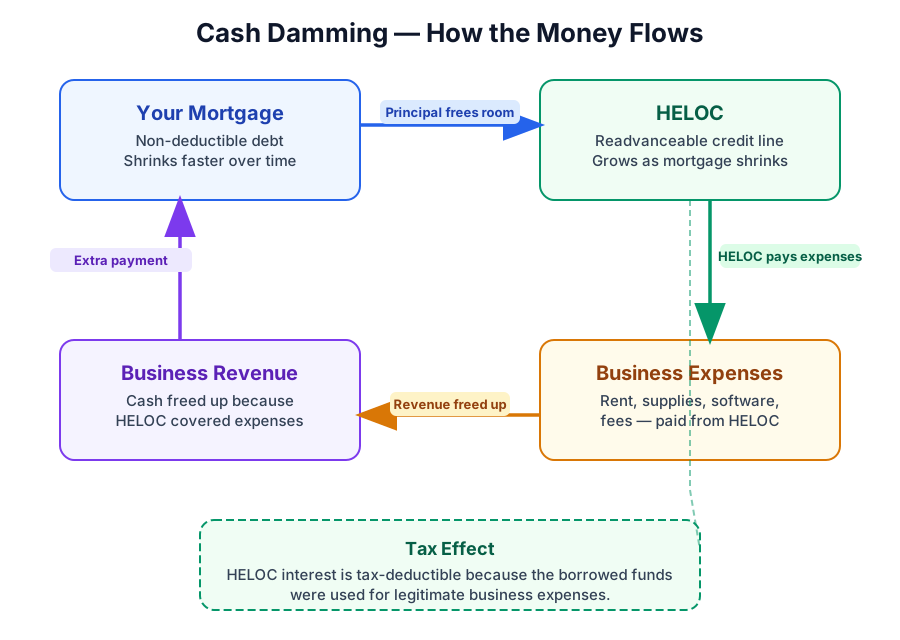
Diagram: mortgage principal paydown creates HELOC room, HELOC funds cover business expenses, and business revenue is redirected to the mortgage while HELOC interest may be deductible when used for business purposes.
Step 1: Make Your Normal Mortgage Payment#
You pay your regular mortgage payment as usual. Part of it goes to interest (not deductible), and part reduces your principal balance.
Step 2: Reborrow the Principal You Just Paid Down#
Your readvanceable mortgage automatically frees up HELOC room equal to the principal you just paid. You draw that amount from the HELOC.
Step 3: Pay Your Business Expenses with HELOC Funds#
Instead of paying your business expenses (office rent, supplies, software, professional fees, etc.) out of your business bank account, you pay them using the HELOC funds.
Step 4: Deposit Your Business Revenue into the Mortgage#
Your business income — the cash you would have used to pay those expenses — gets deposited directly onto your mortgage as a lump-sum prepayment instead.
Step 5: Claim the HELOC Interest as a Business Deduction#
Because the HELOC funds were used exclusively for business expenses, the interest on that HELOC balance is fully tax-deductible as a business expense. You claim it at tax time and receive a refund.
The Result#
Over time, your personal mortgage shrinks faster (because business revenue is being thrown at it), while your HELOC balance grows — but that HELOC balance carries deductible interest. You are converting bad (non-deductible) debt into good (deductible) debt.
A Visual Overview#
| Standard Mortgage | Cash Damming | |
|---|---|---|
| Mortgage interest | ❌ Not deductible | ❌ Not deductible |
| HELOC interest | — | ✅ Tax-deductible (business purpose) |
| Business expenses | Paid from business account | Paid from HELOC |
| Business revenue | Stays in business account | Applied to mortgage |
| Net interest cost | Full mortgage interest | Reduced by annual tax savings |
| Requires investing | No | No |
A Simple Example#
Suppose:
- Mortgage balance: $500,000
- Mortgage rate: 5.5%
- Amortization: 25 years
- HELOC rate: 7.2%
- Monthly business expenses: $3,000 ($36,000/year)
- Annual income: $100,000 (Ontario, ~43% marginal rate)
Each month, you reborrow your mortgage principal repayment through the HELOC and use it to pay $3,000 in business expenses. Your business bank account keeps the $3,000 that was going to pay those expenses, and instead directs it toward your mortgage.
Over the year, the HELOC accumulates roughly the same amount you paid in business expenses. The interest on that HELOC balance — say, $2,000 the first year, growing each year — is fully deductible. At a 43% marginal rate, that saves you roughly $860 in tax the first year alone, growing each year as the HELOC balance increases.
Over a full 25-year amortization, the cumulative tax savings can be tens of thousands of dollars.
Cash Damming vs. the Smith Manoeuvre#
These two strategies are related but distinct. Here is how they compare:
| Smith Manoeuvre | Cash Damming | |
|---|---|---|
| Who it's for | Anyone with a mortgage | Self-employed / business owners |
| What HELOC funds buy | Investments | Business expenses |
| Interest deductible because | Investment purpose | Business purpose |
| Market risk | Yes — you are investing | No — no investments involved |
| Tax benefit source | Investment interest deduction | Business expense deduction |
| Complexity | Moderate | Lower |
Cash Damming is often considered the lower-risk sibling of the Smith Manoeuvre. You are not borrowing to invest — you are simply restructuring how you route money that was already going to leave your hands anyway.
Some business owners use Cash Damming to eliminate their mortgage faster and simultaneously use the Smith Manoeuvre to build an investment portfolio. The two strategies can run in parallel on the same readvanceable mortgage.
Does the CRA Allow This?#
Yes — when structured correctly. The deductibility of HELOC interest under Cash Damming relies on the same provision as the Smith Manoeuvre: paragraph 20(1)(c) of the Income Tax Act, which allows a deduction for interest on money borrowed to earn business or investment income.
What the CRA requires:
- A direct link between the borrowed funds and the business expenses paid
- The expenses must be legitimate, deductible business expenses
- You must keep a clear paper trail — separate accounts, receipts, and records showing the flow of funds
The key is to never mix personal and business funds in the same account. The HELOC funds go directly to business expenses; your business revenue goes directly to the mortgage. The trail must be clean and unambiguous.
Tax law is nuanced. The CRA scrutinises interest deductibility claims, and a mistake in implementation can result in denied deductions. Work with a tax accountant or financial planner who has experience with this strategy.
Requirements#
To implement Cash Damming, you need:
-
A readvanceable mortgage — The most important requirement. Standard mortgages do not allow you to reborrow principal as you pay it down. You need a product specifically designed for this (see below).
-
Regular, ongoing business expenses — The strategy works best when you have consistent monthly expenses: rent, salaries, software subscriptions, professional fees, vehicle costs, etc. One-off or irregular expenses make it harder to implement cleanly.
-
Business income deposited to offset the mortgage — The "dam" only works if the freed-up business cash actually hits the mortgage. If it stays in your chequing account and gets spent, you do not get the acceleration effect.
-
Good bookkeeping — You must document every HELOC draw and the corresponding business expense. Your accountant will need this at tax time.
Readvanceable Mortgages in Canada#
You need a readvanceable mortgage product. Major Canadian lenders that offer these include:
- TD: FlexLine mortgage
- BMO: Homeowner ReadiLine
- Scotiabank: STEP (Scotia Total Equity Plan)
- RBC: Homeline Plan
- National Bank: All-In-One
- Manulife: Manulife One
Products differ in how they track the mortgage vs. HELOC portions and how much flexibility they offer for prepayments. Speak to a mortgage broker who understands the Cash Damming strategy before choosing a product.
Who Is It Best For?#
Cash Damming is most effective for:
- Sole proprietors and unincorporated business owners with significant annual business expenses
- Incorporated business owners who pay themselves a salary or dividends and personally incur business-related expenses
- Freelancers and consultants with recurring professional expenses
- Landlords who personally incur property-related business expenses (note: the rental property itself has separate rules)
- Anyone in a high marginal tax bracket — the higher your rate, the more valuable each dollar of deductible interest
The strategy delivers less benefit if your business expenses are very small or if your marginal tax rate is low.
How the Cash Damming Calculator Can Help#
Understanding the concept is one thing. Seeing exactly how much you could save — year by year — with your actual numbers is what makes the decision concrete.
The Cash Damming Calculator lets you model the full strategy with your real inputs:
- Mortgage balance and rate — your current mortgage
- Amortization period — years remaining
- HELOC rate — the borrowing cost on business-purpose HELOC draws
- Monthly business expenses — the recurring expenses you will route through the HELOC
- Province and annual income — determines your marginal tax rate, which drives the value of the deduction
What the Calculator Shows#
The calculator produces a year-by-year comparison table between a standard mortgage and the Cash Damming strategy:
| Output | Standard Mortgage | Cash Damming |
|---|---|---|
| Mortgage interest paid | Full amount | Same (unchanged) |
| HELOC interest | — | Growing each year |
| HELOC tax deduction | — | Annual deduction on HELOC interest |
| Tax savings | $0 | Compounding over time |
| Net total interest cost | Higher | Reduced by cumulative savings |
At the end, you see:
- Total tax savings over the full amortization
- Net interest cost after deductions
- Total savings vs. conventional mortgage
The Cash Damming Calculator offers scenario modeling with custom inputs, instant updates, and no account requirement.
Common Mistakes to Avoid#
1. Using a standard (non-readvanceable) mortgage The strategy simply cannot be implemented without automatic HELOC readvancement. This is the most common barrier.
2. Mixing personal and business funds The CRA needs a clean, traceable paper trail. Never let HELOC funds touch a personal account or personal expenses, and never let business expenses be paid from personal savings while the HELOC sits unused.
3. Paying non-deductible expenses with HELOC funds Only legitimately deductible business expenses qualify. Personal expenses paid through the HELOC would mean the interest on those draws is not deductible. Keep the usage strictly business.
4. Inconsistent execution Cash Damming works best as a consistent monthly habit. Missing months or letting business revenue accumulate instead of prepaying the mortgage breaks the compounding effect.
5. Ignoring cash flow timing The HELOC interest is a real monthly cost. Make sure your business generates enough cash flow to comfortably cover both the mortgage payment and the growing HELOC interest.
Cash Damming vs. Just Prepaying the Mortgage#
A common question: why not just use business income to prepay the mortgage directly, without the HELOC at all?
You can — and it will pay off your mortgage faster. But you miss the tax benefit. With Cash Damming, the same prepayment effect happens plus you receive an annual tax refund on the HELOC interest, which effectively reduces your total interest cost further.
The HELOC interest cost is real, but it is partially offset by the tax deduction. Whether Cash Damming beats a simple prepayment strategy depends on your interest rates, tax rate, and how large your monthly business expenses are. The calculator lets you compare both scenarios.
Open a Canadian Investment Account#
Some links on this page are referral links. If you open an account through them, I may receive a small bonus at no additional cost to you.
If you are looking for a low-cost platform to hold the non-registered investment portfolio at the core of a Cash Damming strategy, here are two widely recommended options for Canadian investors:
Questrade — Canada's largest discount broker. ETF purchases are commission-free; other trades start from $4.95. Supports RRSP, TFSA, FHSA, RRIF, and non-registered accounts — everything needed for a self-managed Canadian retirement plan.
Wealthsimple — Commission-free stock and ETF trading with a clean, modern interface. Supports RRSP, TFSA, FHSA, RRIF, and non-registered accounts. Also offers Wealthsimple Invest (robo-advisor) for hands-off index investing.
Final Thoughts#
Cash Damming is one of the most underused tax strategies available to Canadian business owners with a mortgage. Unlike the Smith Manoeuvre, it does not require you to invest in the stock market or take on any investment risk. It simply redirects money that was already leaving your bank account — business expenses — through a HELOC, creating a deductible interest trail in the process.
For self-employed Canadians in a high tax bracket with meaningful monthly business expenses, the cumulative savings over a 20–25 year mortgage can be substantial.
Another way to explore this concept is with personal inputs. The Cash Damming Calculator shows how outcomes change under different assumptions.